Topic 1 Question 77
Example Corp. has an on-premises data center and a VPC named VPC A in the Example Corp. AWS account. The on-premises network connects to VPC A through an AWS Site-To-Site VPN. The on-premises servers can properly access VPC A. Example Corp. just acquired AnyCompany, which has a VPC named VPC B. There is no IP address overlap among these networks. Example Corp. has peered VPC A and VPC B.
Example Corp. wants to connect from its on-premise servers to VPC B. Example Corp. has properly set up the network ACL and security groups.
Which solution will meet this requirement with the LEAST operational effort?
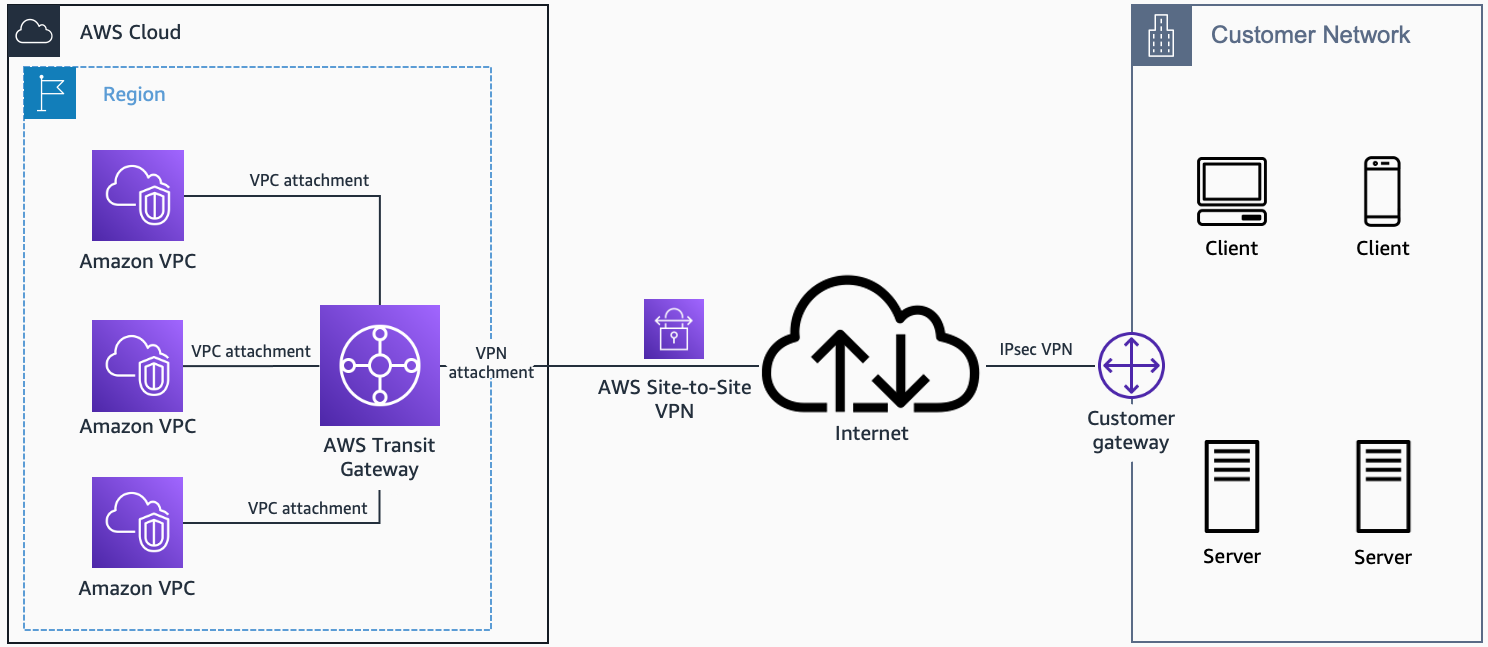
Create a transit gateway. Attach the Site-to-Site VPN, VPC A, and VPC B to the transit gateway. Update the transit gateway route tables for all networks to add IP range routes for all other networks.
Create a transit gateway. Create a Site-to-Site VPN connection between the on-premises network and VPC B, and connect the VPN connection to the transit gateway. Add a route to direct traffic to the peered VPCs, and add an authorization rule to give clients access to the VPCs A and B.
Update the route tables for the Site-to-Site VPN and both VPCs for all three networks. Configure BGP propagation for all three networks. Wait for up to 5 minutes for BGP propagation to finish.
Modify the Site-to-Site VPN’s virtual private gateway definition to include VPC A and VPC B. Split the two routers of the virtual private getaway between the two VPCs.
ユーザの投票
コメント(15)
- 正解だと思う選択肢: A
A. Create a transit gateway. Attach the Site-to-Site VPN, VPC A, and VPC B to the transit gateway. Update the transit gateway route tables for all networks to add IP range routes for all other networks.
This option will allow you to connect from the on-premises servers to VPC B with the least operational effort, as it utilizes the transit gateway to connect all networks and allows for easy updates to the route tables. BGP propagation is not necessary and the use of transit gateway will simplify the traffic routing.
👍 4masetromain2023/01/16 A is correct. on-premise is connected to TGW, use TDW to talk to VPC A/B B: too many VPN connections C: VPC B cannot use VPC A to VPN D: one VPN gateway cannot be associated with more than one VPC
👍 3zhangyu200002023/01/15- 正解だと思う選択肢: A
https://docs.aws.amazon.com/pt_br/whitepapers/latest/aws-vpc-connectivity-options/aws-transit-gateway-vpn.html Transit gateway is an AWS managed high availability and scalability regional network transit hub used to interconnect VPCs and customer networks. AWS Transit Gateway + VPN, using the Transit Gateway VPN Attachment, provides the option of creating an IPsec VPN connection between your remote network and the Transit Gateway over the internet, as shown in the following picture. https://docs.aws.amazon.com/images/whitepapers/latest/aws-vpc-connectivity-options/images/image4.png Option A is the correct answer since the transit gateway will allow both VPCs to connect to the on premises network. Option B suggests the same feature but is using the Transit Gateway in a incorrect way. The soul purpose of the gateway is to have point for interconnectivity.
👍 3rbm20232023/05/07
シャッフルモード